

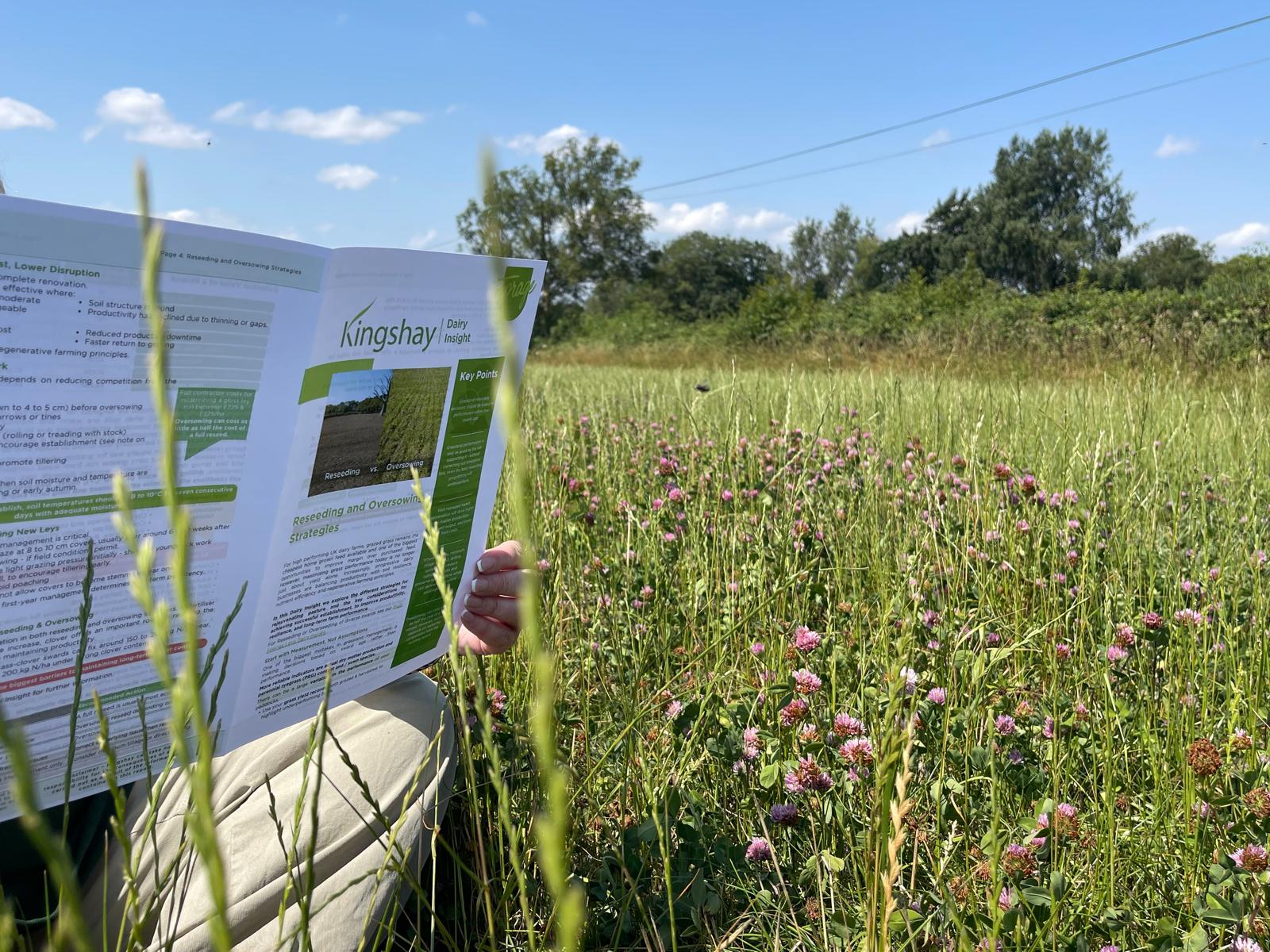
Publications
Our publications provide up-to-date knowledge and practical solutions to everyday challenges to meet the needs of the modern dairy farmer.
Kingshay Dairy Insight Publications
Stay one step ahead with Kingshay’s trusted Insight publications. Practical, expert-led briefings designed for modern dairy farming businesses. Produced since 1991, our concise, easy-to-digest updates deliver the knowledge you need to improve performance, strengthen your business, and support your whole farm team.
Our Insight publications cover all key areas of dairy farming, bringing together technical, research and business information, into clear, actionable advice you can use on farm. Alongside this, our monthly checklist provides timely reminders of essential tasks and highlights important policy changes, helping you stay organised and in control throughout the year.
Written and regularly updated by our specialists, each publication delivers clear, relevant advice in a simple format – ideal for farmers, family members, staff, vets and consultants alike.
A selection of our publications are available to purchase individually here online. To unlock the full library of publications and stay consistently informed, join our community, become a Kingshay member today.

Sign in to download the publications included with your membership, or to purchase a copy.
-

Dairy Insight
Forage Mineral Analysis
Balancing diets is not just about ensuring you provide the correct energy, protein, starch, etc. Minerals are essential for health, fertility and production. With forage contributing a major proportion of the diet, its mineral status will have considerable impact. This dairy insight publication explores the importance of analysing forage minerals, when and how to take a sample, and how to interpret your analysis results.
-
Dairy Insight
Fresh Grass Analysis
Fresh grass analysis is essential for formulating a balanced ration when livestock are at grass, to predict silage quality before cutting and to inform decisions on when to cut. This insight is designed to help you read the analysis results quickly. There are several further insights available covering related management aspects.
-
Dairy Insight
Zero Grazing
Zero grazing is the practice of cutting fresh grass daily to feed to housed cows. It is sometimes referred to as 'cut and carry'. With feed and forage accounting for the largest costs on a dairy farm, maximising the use of grass has the ability to reduce costs and increase profitability. One way to improve milk from forage is via zero grazing. This nsight publication aims to help farmers decide whether zero grazing is for them and provide practical advice on best practice.
-
Dairy Insight
Optimising Fertiliser Use
The costs of ammonium nitrate and urea have more than doubled in the last year, taking prices to over £500 and £600 per tonne respectively. Optimising fertiliser use should therefore be at the forefront of every farmer's mind. With grass being the cheapest feed on the farm, paying attention to detail for efficient production is crucial to maximising margins. This DAIRY insight explores what you can do on your farm to ensure soils are working well, organic manures are used efficiently and fertiliser plans are carefully calculated to make the best use of costly fertilisers.
-
Dairy Insight
Mycotoxins
Mycotoxins are a hidden risk in feeds and forages which can lead to milk suppression, suboptimal fertility and health issues. Once present, they are impossible to remove, so prevention is a must. When issues are suspected, diagnosing the mycotoxins responsible and feeding the correct binder at the right rate is key to success. This dairy insight explores Mycotoxins, how to spot them, prevent them and picking the correct binder when issues are suspected.
-
Dairy Insight
Grass Silage Analysis
Leaving the feeding of your livestock to chance, will only lead to disaster… so what can you do to inform nutritional decisions? This insight publication explores the importance of analysing silage, when and how to analyse, and how to interpret analysis results. Getting the most from silage over winter will allow purchased feed use to be optimised and potentially allow cost savings to be made. Matching the dietary nutrient supply with that of the animals' requirements is crucial in maintaining production. Failure to do this will reduce production efficiency, compromise health and fertility, and profitability. Analysing silage is a crucial factor in this process as silage is the most variable component of the diet.
-
Report
Forage Costings Report 2020
Last published in 2017, this NEW edition of the Forage Costings Report has been fully updated to provide a detailed insight into the costs of producing forage. Using this report enables the reader to compare the cost of a range of different forages and to see how they compare on the basis of their relative value, benchmarked against soya and wheat.
-
Dairy Insight
Getting Ready for the Silage Season
We all know that quality grass silage is the linchpin to cost effective, profitable production. Kingshay figures show that it costs just 6.1ppl to make average quality grass silage, versus 8.1ppl for a typical 18% parlour concentrate (Forage Costings Report 2017). With that in mind, it makes sense to maximise the potential of the silage you make in order to displace expensive bought-in concentrates. This DAIRY insight highlights the considerations for setting yourself up for a successful silage season.
-
Dairy Insight
Precision Cut vs Forage Wagon
Many factors determine the quality of the silage that is ultimately fed to dairy cows. The Forage Cost Report bases yield and cost values on an average of well grown crops in a typical growing year and medium soils. But this is only part of the story. The quality of the grass, the speed and consolidation of the grass in the clamp, the chop length, clamp design, sealing, fermentation characteristics and the feed out all impact on the amount and value of the original crop that is ultimately converted to milk or meat (silo losses). In this DAIRY insight we compare the strengths and weaknesses of Forage Wagons versus Precision Chop systems in their silage making qualities.
-
Dairy Insight
Management Following 1st Cut Silage
With forage larders bare on many farms, optimising the production of quality grass silage, across all cuts is even more vital this season. With that in mind, it's worthwhile giving yourself a refresher of things to consider following first cut; whether it's forage budgeting, silage making strategy or fertiliser regimes. Issued April 2019. About Kingshay […]
-
Dairy Insight
Strategic Worm Control
This insight publication is one in a series of three worming publications: Understanding Anthelmintics and Youngstock Worms, that together provide a comprehensive guide for developing a good worming strategy in conjunction with your vet. In the UK, anthelmintic resistance is common in sheep, and while less so in cattle, it is a growing threat to […]
-
Dairy Insight
Multi Cut Silage
Adopting a multi-cut silage system, which reduces the interval between silage cuts could be one way to help farmers maximise milk from forage – something nearly all respondents from a 2018 Kingshay survey identified as a priority. Cutting more frequently means grass is younger, leafier, higher quality and highly digestible. As a result, cows are […]


Find out how Kingshay can help you and your farming business.
Kingshay have been supporting farmers and providing clarity to farming businesses and the wider industry since 1991.